
GFA World’s Work within the 10/40 Window Map
Understanding the 10/40 Window Map Concept
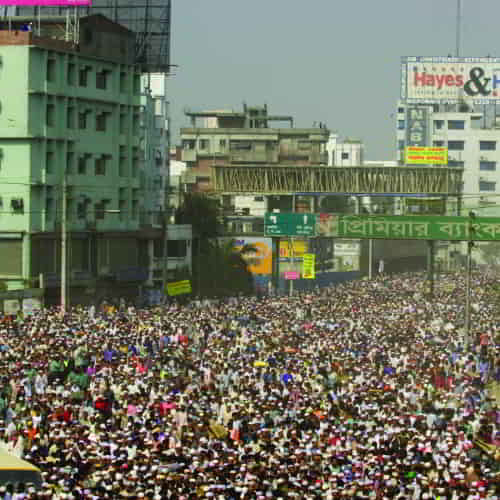
The world’s highest concentration of people who have not heard the Gospel live inside the 10/40 window map.[1] The term “10/40 window” was coined in 1990 by missionary strategist Luis Bush to describe a specific rectangular area of the globe.[2] This area, between 10 degrees south and 40 degrees north latitude, encompasses two-thirds of the global population—4 billion people—and stretches across Northern Africa, the Middle East and Central Asia.
Bush developed this concept while attending the 1989 Lausanne II Conference in Manila. He recognized that the region contained both the world’s greatest spiritual needs and its most significant barriers to Gospel access. Before Bush introduced this framework, the region was known among christian missionary circles as “the resistant belt” due to the significant challenges facing Gospel outreach.
The name itself carries strategic significance. Bush and his team initially called it the “10/40 box,” but his wife Doris suggested renaming it the “10/40 window”—framing the region as a window of opportunity rather than merely a box on a map.[3] This shift in language emphasized hope and possibility for transformation.
GFA World has a map you can request to see the full list of nations in this area. About 95 percent of the people in the window have not yet been reached with the Good News. Furthermore, 87 percent of the 4 billion residents of the window are among the poorest of the poor, with limited or no access to necessities, living on an average of only $250 per family annually.[4]
The Spiritual Landscape
According to Joshua Project, there are approximately 7,215 unreached people groups worldwide. The 10/40 window represented the home of more than 95 percent of these groups as of recent data. An unreached people group is defined as a distinct ethnic community with less than 2 percent evangelical Christian presence and lacking the resources to evangelize themselves without outside help.[5]
The majority of the world’s followers of Islam, Hinduism, and Buddhism also reside within this geographic band. These three major world religions create formidable spiritual and cultural barriers to Gospel witness. Population Education reports that Islam now has nearly 2 billion followers globally, with the highest concentrations in the 10/40 window region.
Many of these religious systems are deeply interwoven with cultural identity and national heritage. For millions living in the window, faith tradition represents far more than personal belief—it forms the foundation of social structures, family relationships, and community belonging.
Regional Challenges and Examples
There is a real dearth of believers in many 10/40 window countries. For example, a mere 1.3 percent of Thailand’s 68 million people are considered Christians, and even fewer are evangelistic.[6] A traditional Asian religion is extremely ingrained into the culture and national identity of Thailand, which makes it difficult for the Thai people to receive the Gospel.[7]
Pew Research Center data shows that over 95 percent of the world’s 1.2 billion Hindus live in the 10/40 window region, primarily concentrated in South Asia. Hinduism has remained closer to its geographic origins than any other major world religion. Buddhism similarly concentrates in this band, with significant populations throughout East and Southeast Asia, particularly in Thailand, Myanmar, and China.[8]
The window encompasses nations with vastly different economic realities. While some countries like Japan and South Korea have developed strong economies, others struggle with extreme poverty and underdevelopment. This economic diversity reminds us that material prosperity does not automatically translate to spiritual openness—even wealthy nations within the window need the Gospel.[9]
The neighboring nation Laos is also largely made up of those who have yet to hear the Gospel. Of the nearly 7 million residents, only 3.2 percent are Christian.[10] Evangelistic progress there was set back when Communist forces took over Laos after the Vietnam War, and nearly two-thirds of the country’s believers fled from the resulting persecution.[11]
Political restrictions remain a significant challenge across many countries in the 10/40 window. Governments in numerous nations either officially oppose Christian work or create substantial obstacles through restrictive regulations and hostile policies. This makes the work of believers in these regions both more difficult and more courageous.
These are just two illustrations of the deep need for missions in this area. Research from The Traveling Team documents that approximately 6,013 distinct people groups totaling 3.28 billion people live within the 10/40 window boundaries. Several of the nations within the 10/40 latitude lines have much higher populations and even fewer believers. Despite the staggering need, only 3 percent of cross-cultural missionaries worldwide focus on reaching these groups.[12] However, only $0.05 of every $100 spent on missions globally goes toward work in the window.[13]
Poverty and Physical Need
World Bank data reveals that extreme poverty has become increasingly concentrated in regions overlapping the 10/40 window. As of 2025, an estimated 831 million people globally live in extreme poverty, defined as surviving on less than $3 per day. The window’s population lives predominantly in areas where this level of deprivation is most acute.[14]
More than 40 percent of people in Sub-Saharan Africa—a region largely within the window—lived in extreme poverty as of 2018, according to World Population Review. The interconnection between spiritual darkness and material poverty creates compounding challenges for communities throughout the region.
When Luis Bush conducted his original analysis in 1990, he discovered that 82 percent of the world’s poorest people lived within the 10/40 window boundaries. This concentration has remained remarkably consistent over the decades. The original research also showed that 84 percent of those with the lowest quality of life—measured by factors including life expectancy, infant mortality, and literacy—resided in the window.[15]
The Foundation of Prayer
As GFA World and other organizations seek to address this disparity and reach those who have yet to hear the Gospel in the 10/40 window, prayer is crucial. In fact, “Gospel for Asia is a ministry founded on, committed to and sustained by the power of prayer.”[16] The organization recognizes that spiritual transformation requires both practical service and faithful intercession. Prayer serves as the foundation undergirding every program, every missionary, and every community touched by GFA’s work.
Prayer maintains our many programs to reach the poor with the Gospel all over the world, including the many people living in the area on the 10/40 window map. Believers around the world have consistently seen God move powerfully in response to prayer—opening closed doors, softening hard hearts, and bringing hope where despair once reigned.
Child Sponsorship: Breaking the Cycle
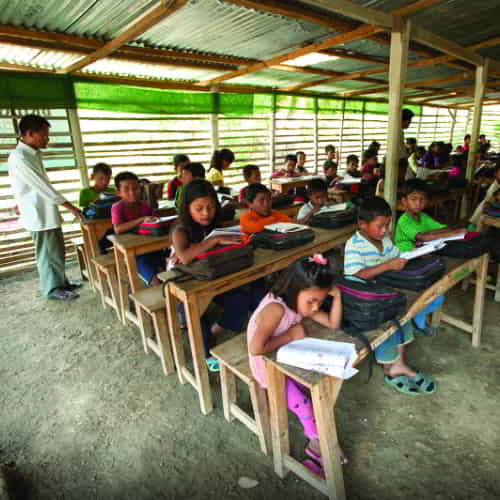
One such effort that needs prayer is GFA World’s Child Sponsorship Program. Many children in impoverished families do not have the opportunity to attend school because they must work at a young age or school supplies and uniforms cost too much. World Vision reports that Sub-Saharan Africa and South Asia—both heavily represented in the 10/40 window—account for nearly 90 percent of children living in extreme poverty worldwide.[17]
These children face overwhelming obstacles to education. In many communities, families must choose between sending a child to school or meeting basic survival needs like food and shelter. Often, if a family is just struggling to survive, school is not prioritized, so the child may have no desire or motivation to go. Without the opportunity to receive an increasingly important education, children are stuck in the same pattern of poverty as their parents.
But GFA’s program encourages students to have hope for a better future, one free from this vicious cycle. The program provides the child and family with vital assistance according to the needs of the community which enables the child to be successful in education. This holistic approach addresses not only educational needs but also nutrition, healthcare, and social support—recognizing that poverty affects every dimension of a child’s life.
The program operates on a community development model where benefits extend beyond individual sponsored children to impact entire families and neighborhoods. This not only changes the kids’ lives but also alleviates pressure from their families as provisions, encouragement and resources become available through sponsorship.[18]
Please pray for the program staff as they tutor and help the children in practical ways. These dedicated workers often serve in challenging conditions, navigating cultural sensitivities while demonstrating Christ’s love through action. Also, pray for the kids and their families as they learn about God’s love for them. Pray specifically that children will discover their identity and worth in Christ, breaking free from systems that have marginalized and devalued them for generations.
National Missionaries: Strategic Effectiveness
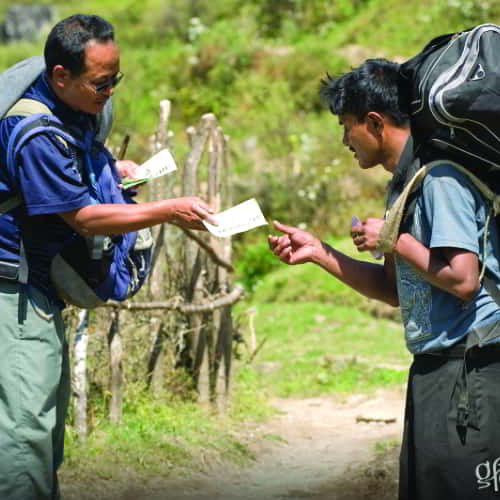
GFA national missionaries also need prayer. These servants have the heart for and are trained to reach their own people with God’s love and establish churches where there are none. Unlike Western missionaries who may face significant visa restrictions, national workers can serve with greater freedom and permanence. More than 85 percent of Asian countries in the 10/40 window do not allow Western missionaries to minister freely, making national workers essential.[19]
They often serve where no one else is working―reaching people, planting churches and transforming lives. National missionaries face fewer cultural obstacles than foreign workers because they know how their neighbors think and what they believe, making them especially effective. They speak the local languages fluently, understand cultural nuances, and can navigate complex social dynamics that might take outside workers years to comprehend.
Being nationals, they also know their community, and that each community can need something different, whether that be mosquito nets, proper sanitation facilities, clean water, medical treatments or any combination of these things.[20] This contextual understanding allows them to minister effectively in communities where barriers of language, culture, and religion would otherwise hinder access to the Gospel.
National missionaries often live sacrificially, choosing to serve in difficult conditions for the sake of the Gospel. Many work in remote villages accessible only by foot, serve in regions with extreme climates, or minister in areas where persecution is a daily reality. Pray for GFA’s national missionaries to endure in their work to make sure needs are met, and pray that people see Christ’s love in action.
Urgent Global Needs
Child sponsorship and national missionaries are just two of the areas where we ask for prayer. There are many more 10/40 window prayer points and urgent requests from all corners of the world. The window encompasses nations where persecution of believers remains severe, where natural disasters frequently devastate communities, and where systemic poverty creates overwhelming challenges.
People need clean water, medicine, blankets, winter clothing and compassion. Our missionaries need prayer support as they endeavor to meet needs and work long, hard days for God’s kingdom. They work in some of the world’s most challenging environments—from scorching deserts to mountainous terrain—often far from medical care and modern conveniences.
The needs span every dimension of human existence: physical, emotional, social, and spiritual. Contaminated water sources cause disease and death. Lack of adequate clothing leaves families vulnerable to harsh weather. Illiteracy traps generations in cycles of poverty. Spiritual darkness keeps millions without hope.
Please consider how you can support GFA’s ministry through prayer, which is always needed and appreciated. Your prayers join with believers worldwide who intercede for these least-reached communities, asking God to open doors that seem closed and to bring light where darkness has reigned for centuries.
Ways to Partner
If you feel led to do more, consider financially partnering with GFA. Sponsoring a child with GFA can help change their life forever, and it only takes $35 a month to help free a child from the cycle of poverty.[21] This monthly investment provides education assistance, nutritious food, healthcare, and the opportunity to hear about God’s love—gifts that can transform not only the child but their entire family.
Another way to get involved is by sponsoring a national missionary. We have over forty years of experience supporting and training these missionaries, and for just $45 a month, you can help fund a worker.[22] Your partnership enables these courageous men and women to dedicate themselves fully to ministry rather than being consumed by the need to earn a living.
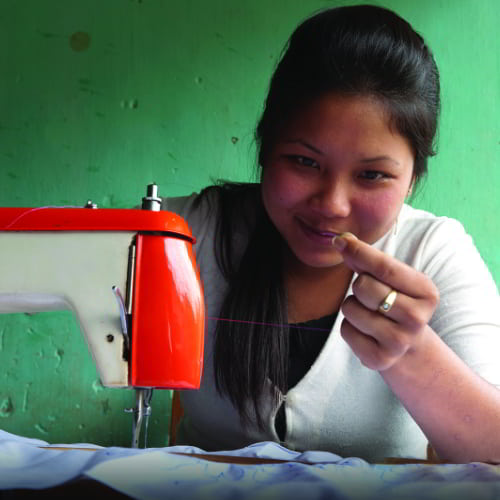
Also consider donating to help us provide clean water wells and filters, income-generating gifts of animals or sewing machines or mosquito nets to protect from illness.
Each of these gifts addresses both immediate physical needs and creates opportunities for spiritual conversations. When a family receives clean water, they experience tangible relief from the burden of waterborne disease—and they witness love demonstrated through action. This vital work, both inside and outside the 10/40 window map, is reaching the least of these with the Good News.
Learn more about what is the great commission[1] “10/40 Window.” Joshua Project. Accessed December 13, 2023. https://joshuaproject.net/resources/articles/10_40_window.
[2] “10/40 window.” Wikipedia. Accessed February 19, 2026. https://en.wikipedia.org/wiki/10/40_window.
[3] “The 10/40 Window: Understanding the World’s Greatest Missions Frontier.” Missionary John Online. Accessed February 19, 2026. https://www.missionaryjohn.online/2025/11/the-1040-window-understanding-worlds.html.
[4] “The 10/40 Window.” Window International Network. Accessed June 28, 2023. https://www.win1040.org/about-the-1040-window/.
[5] “What is an Unreached People Group? Definition and Statistics.” Indo Partners. November 19, 2021. https://www.indopartners.com/learn/unreached-people-group/.
[6] “Day 6: Thailand.” Window International Network. June 2023. https://www.win1040.org/prayercalendar/thailand/.
[7] “Other Countries We Serve.” GFA World. Accessed June 28, 2023. https://www.gfa.org/regions/other/.
[8] “Many religions are heavily concentrated in a few countries.” Pew Research Center. December 8, 2025. https://www.pewresearch.org/short-reads/2025/12/08/many-religions-heavily-concentrated-in-one-or-two-countries/.
[9] “10/40 window.” Wikipedia. Accessed February 19, 2026. https://en.wikipedia.org/wiki/10/40_window.
[10] “Day 11: Laos.” Window International Network. June 2023. https://www.win1040.org/prayercalendar/laos/.
[11] “Other Countries We Serve.” GFA World. Accessed June 28, 2023. https://www.gfa.org/regions/other/.
[12] “Unreached People Groups – An Introduction.” Unreached Network. June 11, 2024. https://www.unreached.network/upg/.
[13] “The 10/40 Window.” Window International Network. Accessed June 28, 2023. https://www.win1040.org/about-the-1040-window/.
[14] “Poverty Overview: Development news, research, data.” World Bank. Accessed February 19, 2026. https://www.worldbank.org/en/topic/poverty/overview.
[15] “10/40 window.” Wikipedia. Accessed February 19, 2026. https://en.wikipedia.org/wiki/10/40_window.
[16] “Join the Prayer Team.” GFA World. Accessed June 28, 2023. https://www.gfa.org/pray/.
[17] “Global poverty: Facts, FAQs, and how to help.” World Vision. October 15, 2025. https://www.worldvision.org/sponsorship-news-stories/global-poverty-facts.
[18] “Monthly Prayer Focus: Pray for Child Sponsorship.” GFA World. Accessed June 28, 2023. https://www.gfa.org/pray/child-sponsorship/.
[19] “What is the 10/40 window?” GFA World. April 19, 2024. https://gospelforasia.com/what-is-the-10-40-window/.
[20] “Monthly Prayer Focus: Pray for National Missionaries.” GFA World. Accessed June 28, 2023. https://www.gfa.org/pray/missionaries/.
[21] “Sponsor a Child with GFA World.” GFA World. Accessed June 28, 2023. https://www.gfa.org/sponsorachild/.
[22] “National Missionaries.” GFA World. Accessed June 28, 2023. https://www.gfa.org/sponsor/.